
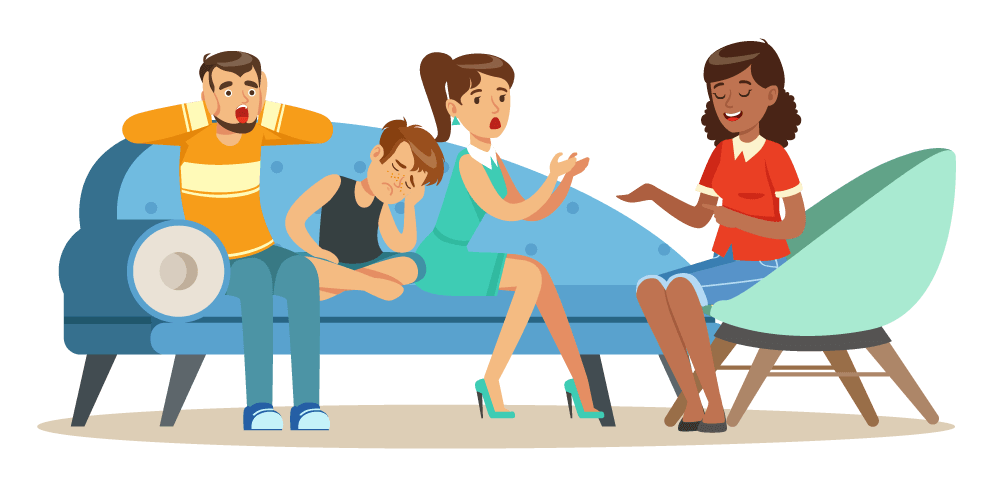
When Every Conversation Became an Argument
For years, the Mehta family had disagreed about almost everything.
Money.
Household responsibilities.
Personal boundaries.
Career decisions.
Even small misunderstandings could turn into major arguments.
Everyone believed they were trying to solve the problem.
But the family kept returning to the same conflicts.
The Real Problem
During family conflict therapy, they discovered something important.
The arguments weren’t always about the topic being discussed.
A disagreement about household responsibilities often represented something deeper.
One family member felt unappreciated.
Another felt controlled.
Someone else felt ignored.
The actual problem was the emotional meaning behind the conflict.
What Is Family Conflict Therapy?
Family conflict therapy is professional psychological support focused on helping family members understand and manage recurring disagreements and relationship difficulties.
A therapist may help family members:
- Identify conflict patterns
- Communicate more effectively
- Express emotions safely
- Listen to different perspectives
- Develop boundaries
- Reduce destructive communication
- Work toward practical solutions
Common Causes of Family Conflict
Family conflicts can arise from many situations, including:
Communication problems
Misunderstandings and assumptions can create repeated arguments.
Different expectations
Family members may have different ideas about responsibilities, relationships, careers, or lifestyle.
Generational differences
Parents and children may have different values or expectations.
Financial stress
Money-related pressure can create significant family tension.
Personal boundaries
Conflicts can occur when family members feel that their privacy or independence isn’t being respected.
Major life changes
Marriage, divorce, relocation, illness, grief, or career changes can alter family dynamics.
How Therapy Can Help Resolve Conflict
Identify the cycle
The therapist may help family members notice how one person’s behaviour triggers another person’s reaction.
For example:
Criticism → Defensiveness → Anger → Withdrawal → More criticism
Recognizing the cycle can help the family interrupt it.
Improve communication
Family members can learn to express concerns without attacking each other’s character.
Practice emotional regulation
Taking a pause before reacting can prevent small disagreements from escalating.
Develop boundaries
Healthy boundaries can clarify responsibilities, privacy, and expectations.
Focus on solutions
Instead of repeatedly discussing who caused the problem, families can work toward practical next steps.
What Therapy Is Not
Family conflict therapy is not about choosing sides.
The therapist’s role is not to declare one family member the winner.
The focus is on understanding the situation and supporting healthier communication and relationship patterns.
When Conflict Becomes Unhealthy
Not every family conflict can or should be resolved through joint discussion.
If there is violence, abuse, intimidation, coercive control, or immediate safety concerns, safety should come first and individual professional support may be more appropriate.
Learning to Disagree Differently
The Mehta family eventually developed a simple rule:
“We can disagree without attacking each other.”
They began taking breaks when conversations became heated.
They stopped bringing up unrelated past mistakes.
They learned to discuss one problem at a time.
Their conflicts didn’t disappear.
But they became more manageable.
Conclusion
Family conflict is not unusual.
What matters is how the conflict is handled.
When repeated disagreements create emotional distance, family conflict therapy can provide professional guidance to understand the pattern, improve communication, and work toward healthier interactions